By Brett Boyer, supervised by Joe Fox and Dr. Geraci, with assistance from Dr. Mancuso, Matthew Mohan, and Tae Kim.
*DISCLAIMER: Joe Fox and the TrainSMART Personal Fitness team are not responsible in any matter whatsoever for any injury that may occur through following instructions contained in this material. Please ensure you have consulted with a physician to be cleared before engaging in exercise, especially if you may have a previous health concern.
Why do you Need Power?
Power is essential for all activities in life to be done in a timely manner, being more powerful will allow you to accomplish more work in a smaller amount of time. Being able to ascend a flight of stairs quickly and with less effort, shoveling the driveway in less time, making the layover flight after racing across the airport, and lifting groceries or grandkids into the car all require power. Catching yourself from falling on the stairs or from slipping on ice is power that is applicable to the real world, and this takes force generation in a timely manner! Muscle mass, VO2max, and strength are highly correlated to longevity; but power may be a greater predictor of longevity and mortality risk. Power is relative to the individual; it may mean a barbell power clean for the 22-year-old athlete or a 6 inch box jump for the 50+ adult. It depends on your fitness level and capacity, and this can be developed with time. Power should make up roughly 10% of your training session, but it is likely the most important part of your training due to its multitude of benefits.
“We lose power at almost twice the rate we lose strength.”-Mike Boyle
Strength and muscle mass are highly correlated to longevity, but muscular power may have better predictive value in determining mortality risk and longevity. Low muscular power is a 3-4 times stronger predictor of mortality than low muscular strength. People in the lowest category of power had a 6-7 times higher mortality risk compared to those in the highest category of power over the course of about 11 years (Araújo et al., 2025).

What is Power?
“Power is the relative ability to move quickly.”-Joe Fox
Power refers to the rate at which you do work. It is a great indicator of overall functional capacity and ability to express strength at higher velocities which is common in sports and in slips, trips, and falls prevention.
Power exercises can help target and build robustness in tissues other than just muscle and specifically can help build bone density, tendon stiffness, and neural efficiency allowing for more coordinated, faster, and stronger movements. Power exercises also increase the rate at which you can produce force which is essential for reactive balance.

How is it Tested?
Power can be tested through a multitude of ways and depending on your fitness and training status there are more appropriate tests for you. A good test of power, strength, and muscular endurance for those older than 60 years old is the 30 second sit to stand test in which subjects are instructed to stand up completely erect from a 17-inch chair as many times as they can in 30 seconds.
Vertical jump height is also a good measure of power for those who are at more advanced training status. Resources for this test were not included due to the increased risk of completing the test.
A practical way to monitor power development in older adults, given the limited normative data for gym-based power tests, is to use a Concept 2 rower or assault air bike and travel as far as possible in 30 seconds. Retest every so often to track relative power capabilities over time. Don’t perform this test if you have or suspect cardiovascular disease, or have any other medical condition, such as low back pain, that prevents your ability to perform vigorous exercise. Note: Set the drag factor on the Concept 2 Rower to the same resistance each time you do the test as machines may vary.
Moderately Active Older Adults 30s Sit to Stand Test Criterion fitness standards to maintain physical independence (Rikli and Jones, 2013):
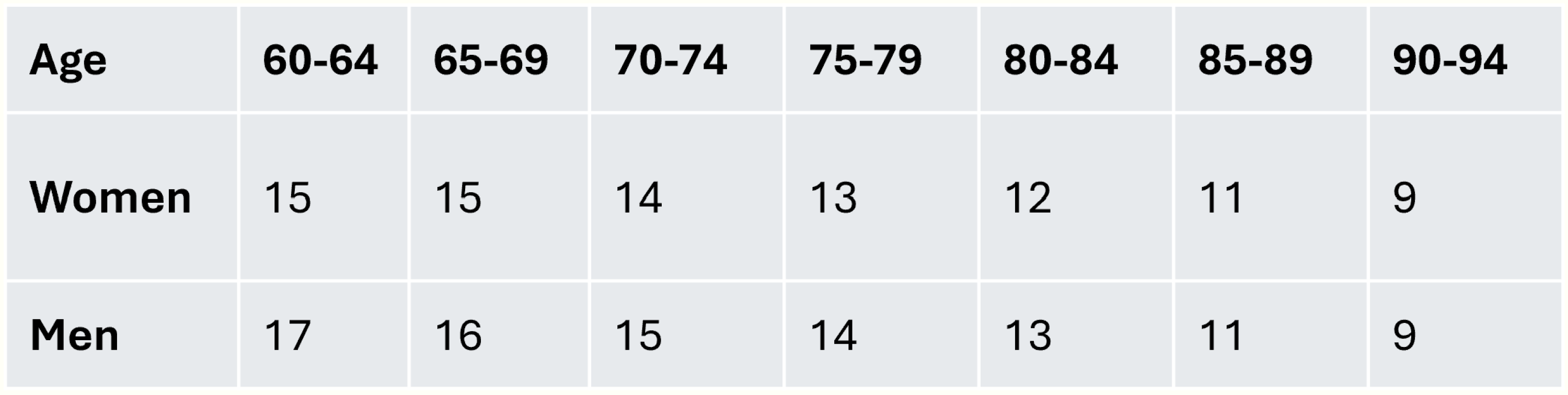
Fitness standards from Rikli and Jones (2013) are designed to identify performance levels associated with maintaining physical independence. These standards assume that functional capacity declines over time in a non-linear fashion, and therefore individuals should aim for scores above the average to build a sufficient buffer. The dataset above does not include adults aged 50–59. However, median (50th percentile) values from a smaller Chilean study (Barros-Poblete et al., 2025) provides useful benchmarks for this age group: 16 repetitions for women and 18 repetitions for men. While these values come from a smaller, country-specific sample, they offer reasonable insight into expected performance. Adults in the 50–59 range should still strive for scores above these medians to offset the typical age-related decline and maximize the buffer between independent living and the threshold at which assistance becomes necessary.
Guidelines
· Quality > Quantity: These exercises should not be fatiguing; the goal is speed and quality not getting your sweat on.
· Intensity: Progress to maximal intent to move the load as fast as you can. Use 0-60% of 1RM for lower body exercises and 30-60% of 1RM for upper body. 60% of 1RM represents a weight you can do 20 reps to fatigue with
· Sets and Reps: 1-3 sets for 6-10 reps per exercise. Note: Depending on your age and training status this recommendation may vary depending on the resource accessed.
· Rest: 2-5 min in-between sets, variable based on exercise and individual. Rest longer than you think you need!
· Frequency: 2-3 times a week on non-consecutive days, depends on the individual.
· Exercise Order: Do these exercises after a dynamic warmup but before strength, hypertrophy (muscle size), and endurance exercises. Do them after a core stabilization routine to have a refractory period of increased stiffness to protect your spine.
· Cut the session or set when velocity decreases or before any technique breakdown..
These represent a combination of ACSM 2009 and NSCA 2016 guidelines.
Safety Considerations
Make sure you have adequate strength above normative values for your age category and progress slowly before adding power exercises to your routine. If you feel unsafe doing the exercise, then you most likely are not ready for it. You can release the weight (ballistic exercises where you throw the implement) if too much stress occurs from decelerating the weight at the end of the range of motion. These exercise types are best suited for outdoors or in large facilities with less foot traffic. Having quality movement is a requirement to do power exercises.
Start with reduced ranges of motions and more forgiving equipment such as sandbags, softer landing surfaces, less intent to move fast, lifting the weight and then dropping it, and less intense power exercises. If you are in a sport or are used to fast movements then doing power exercises that have lighter loads will be the safer option. If you are used to weightlifting, then using heavier loads at slower speeds will be the safer option as you will be limited in how fast you can lift the object due to the heavier weight. Be mindful of tissue recovery window times, with power exercises, the focus is on tendons and muscles so train on non-consecutive days with these movements.

From Gabbett Performance (2025), How Does Tissue-Specific Load Adaptation Fit Within the General Adaptation Syndrome Framework? https://gabbettperformance.com.au/tissue-specific-load-adaptation/
Make sure that you are adequately warmed up by doing a core stabilization routine before as well as a Raise, Activate and Mobilize, and Potentiate protocol (RAMP). This involves raising heart rate, respiratory rate, blood flow, and tissue temperature as well as decreased joint fluid viscosity through a generalized warmup such as light cardiovascular training. Activation and mobilization encompasses dynamic stretching of the musculature being targeted later in the workout and can involve taking joints through a full range of motion through active muscle contractions. Potentiation consists of a specific warmup, in which the specific power exercise chosen will be done at submaximal effort to flow into the session and higher intensity work (NSCA, 2016). This period can be done as a check in to make sure you are ready for the workout.
These components are necessary to minimize injury risk and to boost your performance during the workout. Think of this as a tissue preparation phase that allows for optimum performance. Racehorses and high performing athletes don’t skip warmups, neither should you. Power exercises should be implemented into a comprehensive program that prioritizes longevity, but as with any mode of training it comes with inherent risks. This makes the frequency in which the exercises are done vitally important. Radaelli et al. 2023 suggests 2-3 sessions per week with at least 48 hours between sessions. This allows for adequate tissue recovery time as outlined by the graph shown on the previous page. You may require longer recovery times such as 72 hours between sessions. Frequent consecutive sessions can lead to adverse events such as muscle strains and tendinopathies.
Injuries typically occur “when individuals exert themselves at near the maximal muscular force, or perform a combination of heavy and repetitive workload executed until exhaustion” (Randaelli et al., 2023). If implementation of this training exacerbates or produces clinical symptoms not limited to osteoarthritis, joint pain, or fasciitis then the individual should reach out to a qualified health care professional.
Key Takeaways
· Power declines nearly twice as fast as strength.
· Higher muscular power strongly predicts longevity. Older adults with low relative power have a 6–7× higher mortality risk over ~11 years (Araújo et al., 2025).
· Power = Force × Velocity
· Training power improves more than muscle, it enhances bone density, tendon stiffness, neural efficiency, and reactive balance.
· Quality beats quantity: low reps, high intent, long rest, and stop when velocity drops or fatigue hits.
· Progress gradually through exercises, matching your strength, movement quality, and comfort level. Reach out to an exercise professional to do this in a safe way.
· Safety first: meet basic strength norms, use forgiving equipment, start with small ranges of motion, and train on non-consecutive days.
Practical Takeaway: Incorporate 2-4 power-based exercises into your workout and do them 2-3 times a week using upper and lower body exercises. Do them after a dynamic warmup and core stabilization routine and before other exercises with different adaptation goals.
References
American College of Sports Medicine (2009). American College of Sports Medicine position stand. Progression models in resistance training for healthy adults. Medicine and science in sports and exercise, 41(3), 687–708. https://doi.org/10.1249/MSS.0b013e3181915670
Araújo, C. G. S., Kunutsor, S. K., Eijsvogels, T. M. H., Myers, J., Laukkanen, J. A., Hamar, D., Niebauer, J., Bhattacharjee, A., de Souza E Silva, C. G., Franca, J. F., & Castro, C. L. B. (2025). Muscle Power Versus Strength as a Predictor of Mortality in Middle-Aged and Older Men and Women.Mayo Clinic proceedings, 100(8), 1319–1331.
Barros-Poblete, M., Torres-Castro, R., Otto-Yáñez, M., Núñez-Cortés, R., Barros, M., Valencia, C., Campos, A., Jadue, L., Manríquez-Hizaut, M., & Solis-Navarro, L. (2025). 30 Seconds Sit-to-Stand Test: Reference Values for the Chilean Population. Revista medica de Chile, 153(5), 329–339. https://doi.org/10.4067/s0034-98872025000500329
CFSC Certified Functional Strength Coach Level 1 Manual. (n.d.). Certified Functional Strength Coach.
Ferriss, T. (2025, February 26). Simple exercises that can repair tendons — Dr. Keith Baar [Video]. YouTube. https://www.youtube.com/watch?v=undefined
Gabbett, T. (2025, November 27). How Does Tissue-Specific Load Adaptation Fit Within the General Adaptation Syndrome Framework? – Gabbett Performance. https://gabbettperformance.com.au/tissue-specific-load-adaptation/
Mathews, S. (2014, August 7). Simple & Sinister Training for Kettlebell Sport Athletes. StrongFirst. http://www.strongfirst.com/hardstyle-for-the-sport-guy-simple-sinister-for-kettlebell-sport athletes/
National Strength and Conditioning Association. (2016). Essentials of strength training and conditioning (G. G. Haff & N. T. Triplett, Eds.; 4th ed.). Human Kinetics.
Radaelli, R., Trajano, G. S., Freitas, S. R., Izquierdo, M., Cadore, E. L., & Pinto, R. S. (2023). Power training prescription in older individuals: Is it safe and effective to promote neuromuscular functional improvements? Sports Medicine, 53, 569–576.
Rikli, R. E., & Jones, C. J. (2013). Development and validation of criterion-referenced clinically relevant fitness standards for maintaining physical independence in later years. The Gerontologist, 53(2), 255–267. https://doi.org/10.1093/geront/gns071
Q4E Case Study 04 – Power. (n.d.). Quintic Sports. Retrieved April 17, 2026, from https://www.quinticsports.com/case-study/q4e-case-study-04-power/
Special Thanks
Dr. Geraci was an invaluable resource during the project and has a wealth of knowledge in the sports medicine field. Please visit his website for more information about training for longevity and the sports medicine field: https://geracispine.com/